
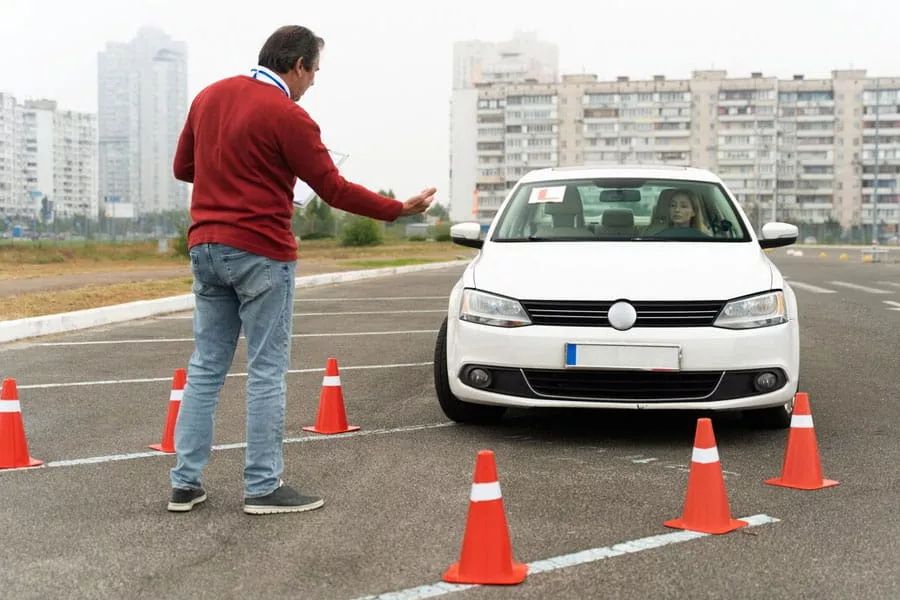
It is an exciting and nerve-wracking experience to prepare to take your road test. You do not wish to fail the first try. Nevertheless, many learners question whether real-world driving lessons are useful. Others believe family practice is sufficient. Some favor the professional advice. Worth it then, before the road test, are these lessons? Let’s break it down.

What Are Behind-the-Wheel Driving Lessons?
Behind-the-wheel lessons allow you to sit in the driving seat with a qualified instructor. You train in real-life scenarios on the road. You learn how to deal with traffic, lights, and narrow lanes. Above all, you have confidence.
Structured lessons have a plan, unlike casual practice. Teachers concentrate on road test abilities. They immediately rectify errors. Consequently, you become better faster.
Why Many Learners Struggle Before the Road Test
Many students practice studying for weeks. Still, they feel nervous. There are several reasons.
To begin with, family members might be unaware of test standards. They might skip key skills. They can neglect parallel parking laws, e.g. Second, they pay much attention to everyday driving, but not to test scoring. Thus, students do not get crucial information.
Nerves are also of enormous importance. You might drive well at home. And yet you have a freeze-up in the exam. Professional lessons help alleviate such fear.
The Benefits of Professional Instruction
Behind-the-wheel driving lessons offer clear advantages.
1. Targeted Test Preparation
The teachers are aware of what examiners require. They not only teach correct lane changes, checking the mirror, and smooth stops, but also teach how to handle the unexpected. In addition, they replicate actual test routes. As such, there is nothing strange during an exam.
2. Immediate Feedback
When practicing alone, it is possible to repeat. But a teacher does correct mistakes immediately. You thus develop more protective habits.
3. Confidence Building
Trust is built through mentoring. You face busy intersections. You do defensive driving. Gradually, fear decreases.
4. Increased Traffic Laws Knowledge
4. Increased Traffic Laws Knowledge
Lots of students forget small, important rules. For example, failures are common with rolling stops. Structured lessons reinforce these rules. Consequently, you avoid expensive mistakes.
Are They Really Worth the Cost?
Cost is a concern for students and parents. There has to be an investment in lessons. Nevertheless, road-test failure is also costly in terms of time and money. You may need to rebook. You may take extra days off.
Thus, the savings of money are usually long-term in professional lessons. They give you a higher chance to pass on your first attempt. Moreover, they reduce stress.
Consider it a safety investment. Driving is a lifelong competency. Some habits help avert accidents. That is not just a pass on the test.
When Should You Take Behind-the-Wheel Lessons?
Timing matters. Preferably, you must attend classes a few weeks before your exam. To begin with, learn the basics of driving under the supervision of a licensed adult. After that, arrange professional meetings.
This strategy is effective since you are familiar with the fundamentals. Then your skills are polished by instructors. They focus on test details. You therefore go into the test ready.
What Skills Do Instructors Focus On?
Professional classes focus on the main areas of the road test:
- Parallel parking
- Three-point turns
- Proper signaling
- Lane discipline
- Fluid acceleration and deceleration.
- Defensive driving
There is also training by instructors to remain calm. They are taught breathing methods. They encourage focus. Hence, you are likely to cope with pressure.
During this stage, most learners opt for schools they have confidence in, such as All Class Drivers. They appreciate the systematic instructions and the professional teachers. Consequently, they are better equipped on the eve of test day.
How Lessons Improve Safety Beyond the Test
Passing the test matters. Nevertheless, it is safer to drive.
Awareness is enhanced during behind-the-wheel driving lessons. You learn to predict hazards. You are taught to keep safe distances. Moreover, you train driving at night and on highways where you can merge.
Such experiences provide real-world driving training. Thus, lessons provide long-term advantages.
Comparing Practice With Family vs. Professionals
Both options help. Nevertheless, they are used in other ways.
Family members are supportive and accommodating. You can practice anytime. Nevertheless, they can ignore errors. They can also transmit poor habits.
According to professional standards, teachers are expected to be strict. They evaluate objectively. They get you ready to meet the scoring requirements. Thus, their feedback is more trustworthy.
A mix of the two strategies is usually the most effective. To begin with, establish a sense of comfort with family. Next, practice with a professional trainer.
Common Mistakes That Lessons Help Prevent
Several students have failed because of minor mistakes. These include:
- Forgetting blind spot checks.
- Rolling through stop signs
- Poor parking alignment
- Going faster than necessary.
- Waiting too long at the crossroads.
The lessons behind the wheel are handled early on these issues. Thus, one is not caught unawares during the test.
Mental Preparation Matters Too
Confidence has an impact on performance. You may know every rule. Nevertheless, anxiety may influence judgment.
Professional instructors make up mock tests. They simulate exam pressure. Consequently, you get used to evaluation.
Besides, they exchange useful tips. As an example, they recommend the regularity of breathing and comprehensibility. These tiny tricks require a lot of concentration.
So, Are They Worth It?
In most cases, yes. Structured guidance is offered through the behind-the-wheel driving lessons. They increase confidence. They reduce mistakes. But most importantly, they will increase your probability of passing.
The practice with family is helpful; however, knowledge gaps are bridged with professional teaching. It makes you ready to take actual exams. Thus, numerous students gain a lot. It is a big milestone in driving. You are willing to begin well, without fear. Proper training investment helps in that objective.
If you want focused preparation and experienced guidance, consider All Class Drivers. They help learners refine skills, build confidence, and approach the road test with clarity.